
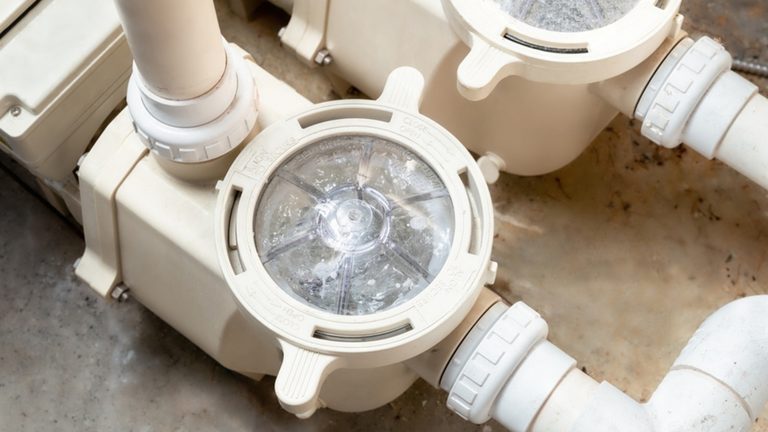
During an Atlanta summer, most in-ground pools need 8 to 12 hours of pump run time per day. That’s about double what most people run in April. The gap between those two numbers is the number one reason we get called out to green pools in June and July.
Why a range instead of one number? Because the honest answer depends on your pool. Water temperature, pump size, filter type, how many kids cannonball into it on Saturday, how much your oaks dump into the water. All of it moves the number up or down. This guide covers how to find your pool’s real run time, why it climbs in summer, and how to keep a 10-hour schedule from wrecking your Georgia Power bill.
Why summer changes the math
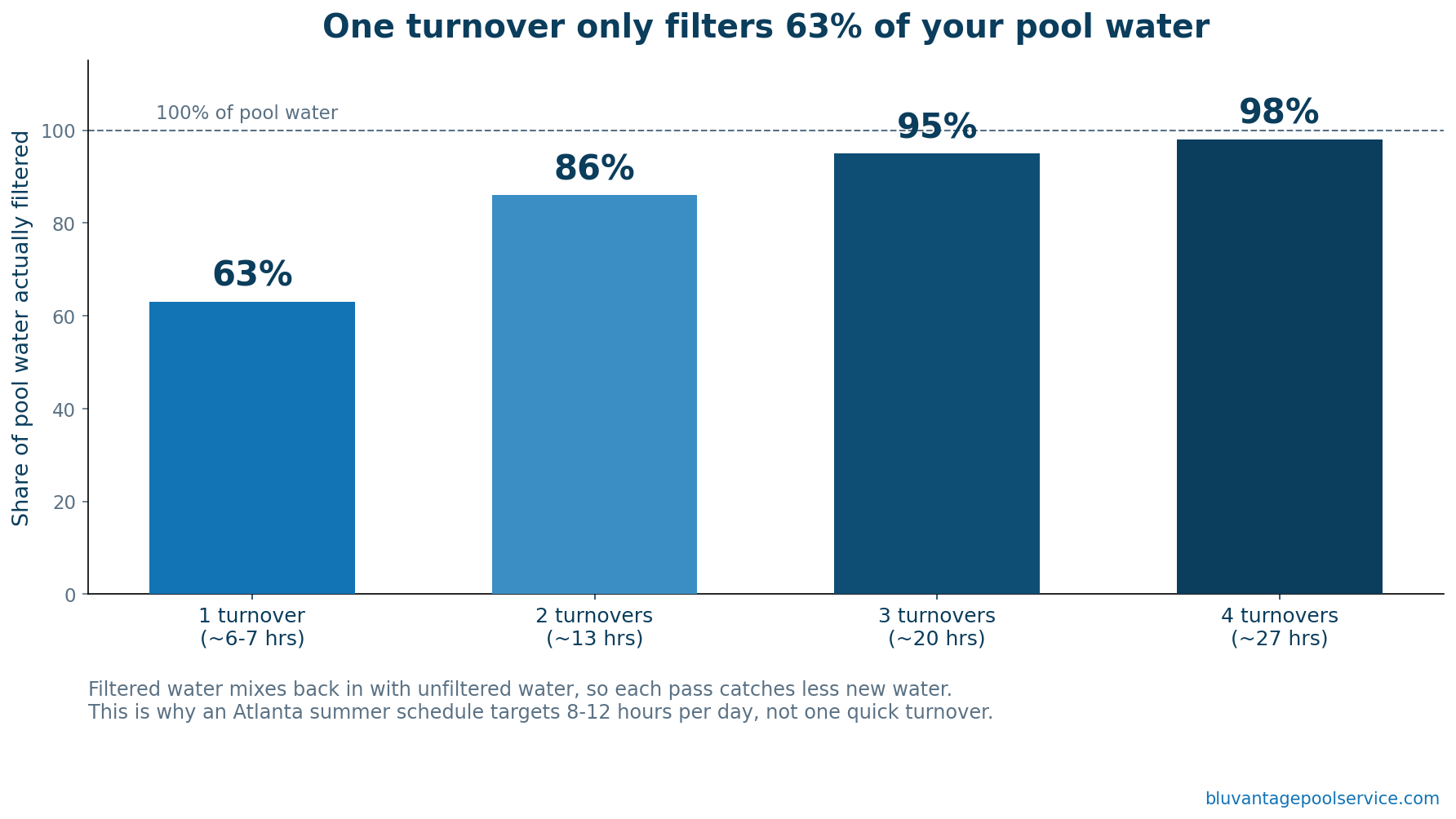
Your pump has one job: move a volume of water equal to your whole pool through the filter at least once a day. That cycle is called turnover. Here’s the part most people don’t know. One turnover doesn’t filter every gallon. Filtered water keeps mixing back in with unfiltered water, so a single turnover only catches about 63 percent of what’s in the pool. A second pass gets you to roughly 86 percent. It takes about four turnovers before 98 percent of the water has actually been through the filter.
In cooler months, one turnover is plenty. Algae and bacteria barely grow in 60-degree water.
By late June, pool water around Metro Atlanta sits at 84 to 90 degrees, and everything speeds up. A pool can be clear on Friday and cloudy by Monday if circulation and chlorine fall behind. Warm water burns through sanitizer faster too. The dead spots near steps, behind ladders, and in deep-end corners are where a bloom starts first.
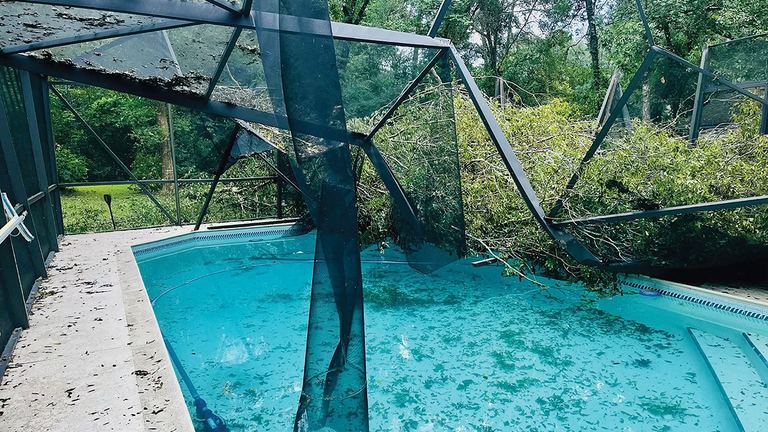
Then there’s the tree canopy. Pools in older neighborhoods like Buckhead, Chastain Park, Ansley Park, Morningside, Sandy Springs, Dunwoody, and Decatur sit under mature oaks and pines that drop pollen, seed casings, and who knows what else into the water all season. Organic debris eats chlorine and feeds algae, so heavily shaded pools usually need run times at the top of the range.
Newer communities have the opposite problem. Subdivisions in Milton, Alpharetta, Johns Creek, Woodstock, and Canton tend to have less tree cover and more direct sun. Less debris, hotter water. A full-sun pool in Milton can hit 90 degrees by mid-July, and water that warm chews through chlorine even when it looks spotless. Either way summer pushes the run time up. The reason just depends on your zip code.
How to calculate your pool’s actual turnover time
Want the real number instead of the rule of thumb? The math is simple:
- Find your pool volume in gallons. A typical 16×32 in-ground pool holds 18,000 to 20,000 gallons.
- Find your pump’s flow rate in gallons per minute (GPM). This depends on horsepower, plumbing size, and filter resistance. Most residential setups move 40 to 60 GPM.
- Divide volume by flow rate, then divide by 60. That’s your hours per turnover.
A 20,000-gallon pool moving 50 GPM turns over in about 6.7 hours. In summer you want one full turnover plus a cushion, which is how you land at 8 to 12 hours for most Atlanta pools. Commercial pool systems are built the same way, moving about 25 percent more water than the minimum requirement, because contaminants keep entering the water around the clock whether anyone is swimming or not.
One catch: the number on your pump label is optimistic. Undersized plumbing, a dirty filter, or a worn impeller all drag down real-world flow, sometimes by a lot. If you’ve never had your flow rate checked, a technician can read it from filter pressure and plumbing during a routine visit. We check circulation on every weekly pool maintenance stop for exactly this reason.
Single-speed vs. variable speed: the cost question
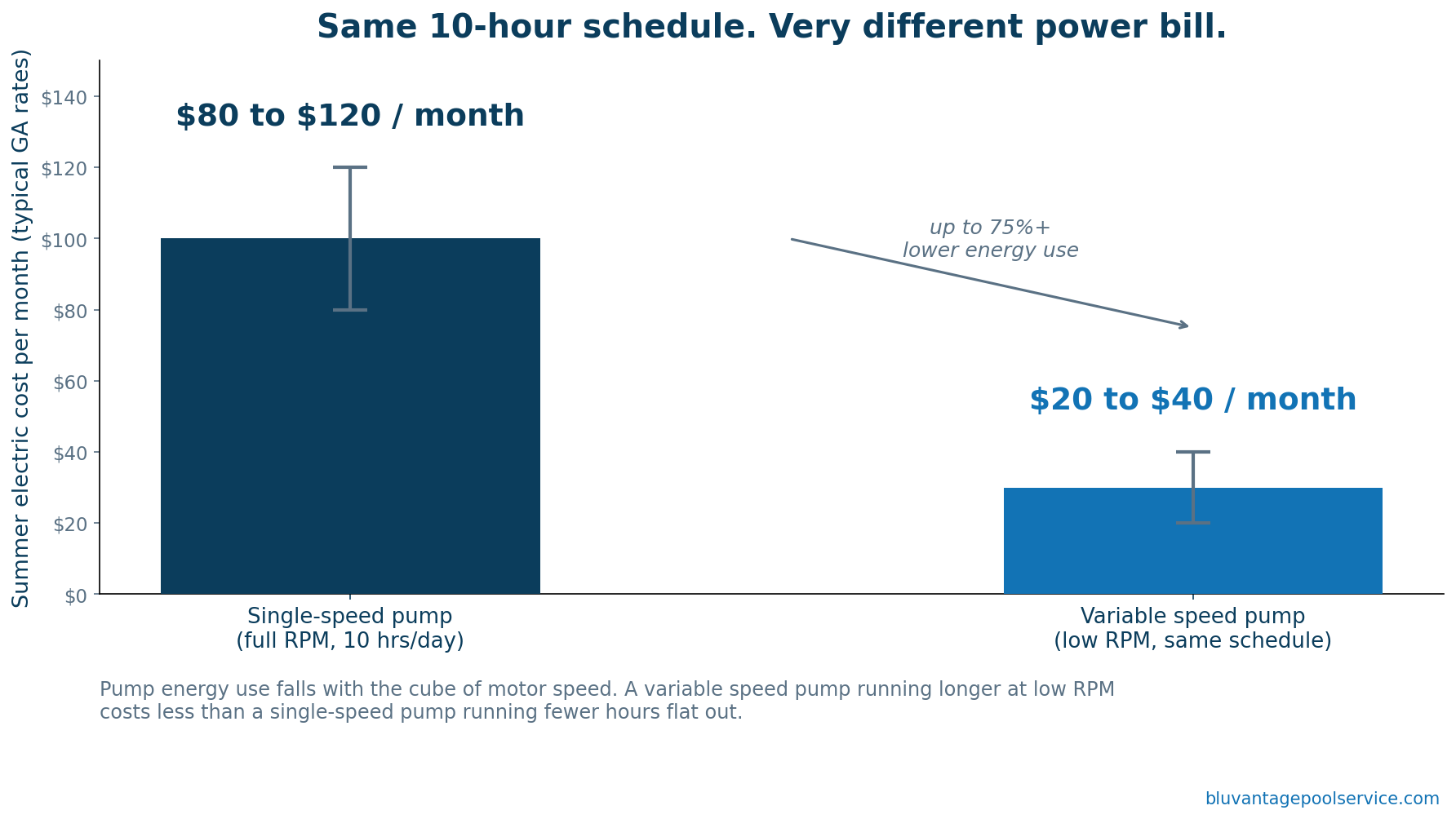
Running a single-speed pump 10 to 12 hours a day works. It’s also expensive. An older 1.5 HP single-speed pump pulls 1,800 to 2,000 watts, and at 10 hours a day through a Georgia summer that one piece of equipment can add $80 to $120 a month to your bill. Georgia Power on the north Atlanta side or Cobb EMC out in East Cobb, Marietta, and Kennesaw, doesn’t matter. Both will notice.
A variable speed pump (VSP) rewrites the math. Pump energy use falls with the cube of motor speed, so cutting the speed in half cuts energy draw way more than half. In real-world operation you’re usually looking at 75 percent or better. A VSP loafing along for 12 hours at low RPM typically costs less than a single-speed pump hammering away for 6. And the filtration is actually better, because slower water gets cleaned more thoroughly on its way through the filter.
Here’s the counterintuitive part: a bigger pump is not a better pump. High flow shoves debris deeper into a sand filter bed instead of trapping it near the top, and it can push water faster than your plumbing and drain covers are rated to handle. Right-sized and slow beats big and fast. That’s the whole idea behind variable speed.
The industry has mostly stopped arguing about this. Pentair, Hayward, and Jandy have all gone heavily variable speed, and in a climate like Atlanta’s the energy savings usually pay for the pump within two to three swim seasons. Most homeowners we install for watch their summer pump cost drop 60 to 80 percent while running more hours than they did before.
If your pump is over 8 years old, is a single-speed model, or needed a pool pump repair in the past year, price out a replacement before you pay for another season of high bills. Our equipment upgrades and automation team handles VSP installs and can add an automation controller so the schedule adjusts itself.
The right schedule, not just the right total
When you run the pump matters less than people think. Two exceptions.
Run it during and after heavy swimming. Sunscreen, sweat, and everything else swimmers bring in needs to reach the filter fast. Pool party Saturday afternoon? The pump should be working Saturday night.
And if you chlorinate through an inline feeder or salt cell, the pump has to run for sanitizer to get into the water at all. Splitting the run into two blocks, early morning and late afternoon into evening, keeps chlorine spread out far better than one long block followed by 14 stagnant hours.
On a time-of-use electric plan? Shift the heavy block to off-peak hours. With a VSP and automation you program it once and never think about it again.
Signs your current run time is too short
The pool will tell you. Cloudy water that clears when you manually run the pump longer. Algae showing up first in corners and on steps. Chlorine readings that swing wildly between visits. A waterline that feels slick to the touch. Any of these in June or July usually means the spring schedule hasn’t caught up with summer. Expect the same warning signs after a good Atlanta afternoon thunderstorm, since runoff and wind-blown debris dump exactly the kind of organics a longer run time is supposed to clear.
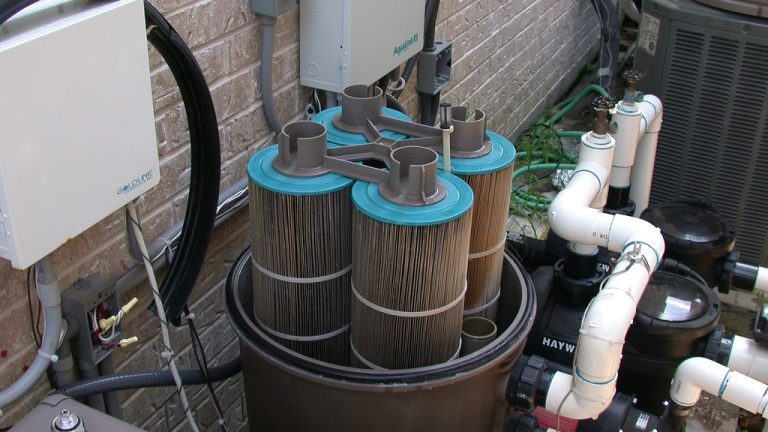
Before touching the schedule, check the free fixes first. A dirty filter, a packed skimmer basket, or a clogged pump strainer can quietly choke your flow rate well below what the system can do, and clearing them usually fixes circulation on the spot. If the filter itself is overdue for a deep clean, our pool filter cleaning service handles that. More hours won’t help a system that can’t breathe.
And if the pool has already gone from cloudy to green, run time alone won’t save it. That’s a chemistry and filtration recovery job, and our green-to-blue algae treatment process exists for exactly that situation.
Frequently Asked Questions
How long should I run my pool pump in summer in Georgia?
Most in-ground pools in Metro Atlanta need 8 to 12 hours of daily pump run time from June through September. Warm water speeds up algae growth and chlorine loss, so summer run times are about double what the same pool needs in cooler months.
Is it OK to run a pool pump 24 hours a day?
Yes, it’s safe. With a variable speed pump at low RPM it can even be the cheapest option, and continuous slow circulation produces excellent water quality. With a single-speed pump, 24-hour operation is usually overkill and expensive.
Should I run my pool pump at night or during the day?
Daytime running helps chlorine fight algae while sun and heat are driving growth. Nighttime running saves money on time-of-use electric plans. For most Atlanta pools, splitting the time between a morning block and an afternoon-to-evening block works best.
How much does it cost to run a pool pump per month?
A 1.5 HP single-speed pump running 10 hours a day costs roughly $80 to $120 per month at typical Georgia electric rates. A variable speed pump on the same schedule at reduced RPM usually runs $20 to $40.
Will running my pump longer fix a green pool?
No. Once algae blooms, the pool needs chemical treatment and aggressive filtration, often including a filter cleaning. Longer run time prevents algae. It won’t kill an established bloom.
Final thoughts
The right pump schedule is the cheapest insurance your pool has. Eight to twelve hours a day through an Atlanta summer keeps the water moving and the algae losing. If the electric bill stings, the answer isn’t fewer hours. It’s a variable speed pump.
BluVantage Pool Service maintains pools across Metro Atlanta, from Buckhead, Brookhaven, Sandy Springs, and Dunwoody up to Milton, Alpharetta, Johns Creek, and Roswell, and west through East Cobb, Marietta, Kennesaw, Smyrna, and Vinings. Every weekly visit includes an equipment and circulation check by CPO-certified technicians. See the full list of neighborhoods we serve, and if you suspect your pump schedule or equipment isn’t keeping up with the season, call 404-224-9387 or schedule a pool assessment and we’ll dial it in for you.