
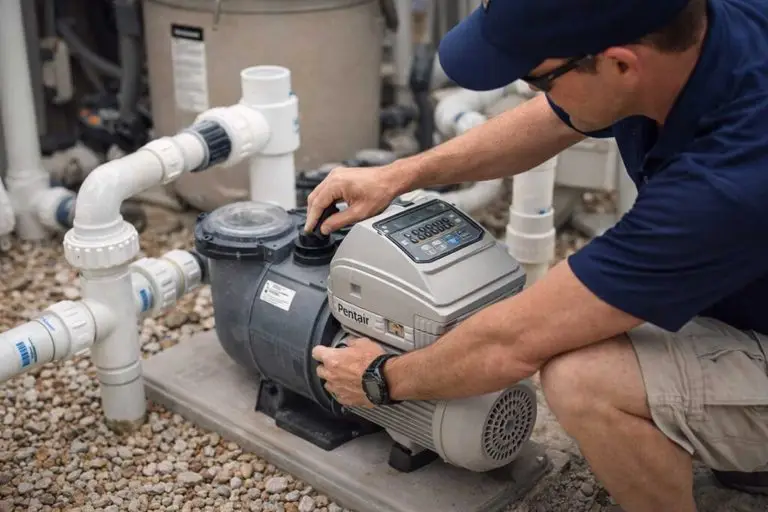
The pump is the heart of your pool, and when it starts screeching, humming, or leaking, you face the classic equipment-pad question. Repairs run $100 to $700 depending on the part. Full pool pump replacement cost lands between $800 and $2,500 installed for the variable-speed models most Atlanta pools get now. The right call depends on three things: what actually failed, how old the pump is, and a federal rule that quietly changed the math in 2021.
We make this call on equipment pads across Metro Atlanta every week. Here is the same framework our technicians use, with real numbers attached.
What pool pump repairs cost in 2026
Most single repairs land near $350, and the part that failed sets the bill. Industry cost data and our own service work agree on these ranges:
- Shaft seal replacement, $100 to $250. The mechanical seal keeps water out of the motor. Caught early, this is a cheap fix. Ignored, the leak reaches the motor bearings and turns into a motor bill.
- Electrical fixes like a capacitor, $100 to $250. The usual culprit when a motor hums but will not start.
- Impeller work, $120 to $400. Clogs are cleared cheap. A worn or damaged impeller costs more.
- Bearing replacement, $150 to $350. The screeching-pump repair, when the motor is otherwise healthy.
- Motor replacement, $200 to $800, averaging around $500. The biggest repair, and the one where the replace question gets serious.
Labor in the Atlanta market runs $75 to $150 an hour, and small jobs are often flat-rate. If your pump is misbehaving, our pool pump repair techs diagnose before quoting, because half of “dead pump” calls turn out to be something smaller.
What pool pump replacement costs installed
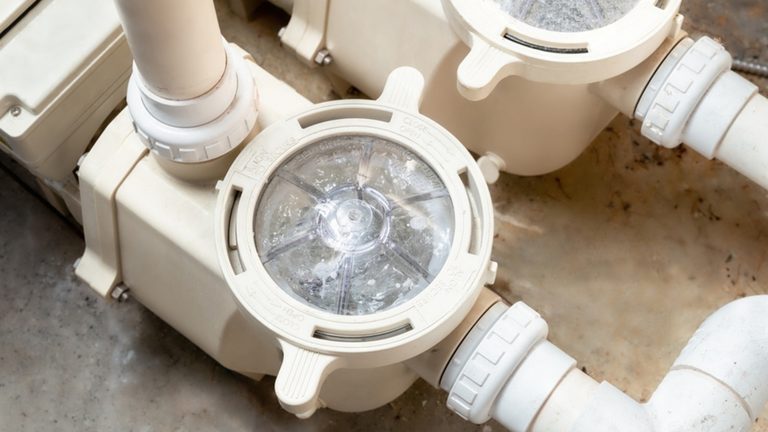
For the unit itself, single-speed pumps run $250 to $1,000, dual-speed $300 to $1,600, and variable-speed $800 to $2,500. Installation labor adds about $200 for a same-model swap. Switching brands runs $280 to $500, because the new pump usually needs plumbing adjustments and rewiring. Nationally, most homeowners land around $1,300 all-in, and Atlanta tracks close to that.
One sizing note before you shop. Bigger is not better with pumps. An oversized pump pushes water faster than your plumbing and filter are designed to handle, wastes electricity every hour it runs, and can starve itself into cavitation. The right size comes from your pool’s volume and plumbing, not from buying the biggest horsepower on the shelf. A properly matched smaller pump running longer beats an oversized one running hard, on both water quality and the power bill.
Those single-speed prices also come with an asterisk, and it is a big one.
The 2021 federal rule that changed this decision
Since July 2021, a Department of Energy efficiency standard has applied to new and replacement inground filter pumps above 1.0 total horsepower. In practice, only variable-speed pumps hit the required efficiency levels. Manufacturers stopped producing the old full-size single-speed models, and the remaining inventory has largely dried up. Trade coverage from Pool & Spa News lays out the rule’s history.
What this means at your equipment pad is simple. Nobody will make you unplug a working single-speed pump. But when yours dies, a like-for-like replacement usually is not on the table anymore. Swapping just the motor sits in a gray area and gets harder to source every season. For most Atlanta homeowners, the real choice today is a repair that extends the old pump’s life or an upgrade to variable speed.
The consolation is that the economics genuinely favor the upgrade. A full-RPM single-speed pump on an Atlanta summer schedule costs $80 to $120 a month in electricity. A variable-speed pump running the same hours at low RPM costs $20 to $40. That $60 to $90 monthly gap, across our long April-to-October season, typically pays back the variable-speed premium in about two seasons. Our guide to pool pump run time in an Atlanta summer shows the schedule side of that math.
Repair or replace: the rules we use on service calls
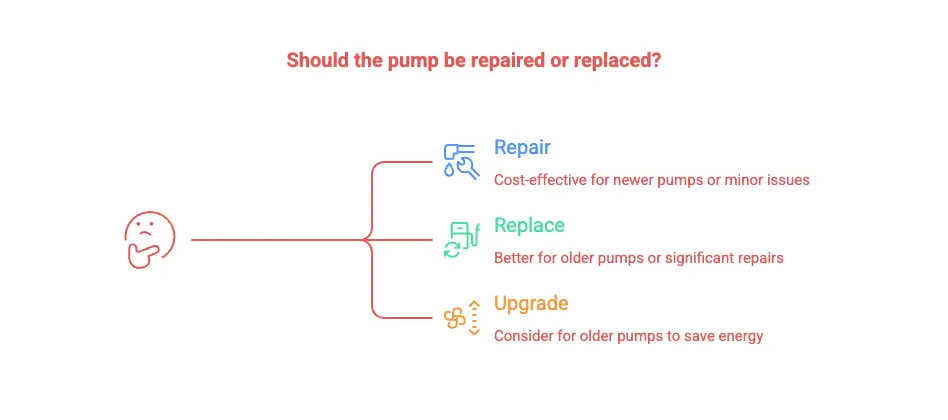
Start with the 50 percent rule. When a repair quote passes half the cost of a new pump installed, replacement wins. A $500 motor job on a pump you could replace for $1,300 is a close call. The same $500 on a $2,000 setup is an easy repair.
Then weigh the age. Under 5 years old, repair almost everything, since the wet end and plumbing have plenty of life left. Between 5 and 8 years, apply the 50 percent rule honestly and factor in the energy savings you are giving up. Past 8 years, put repair money toward a variable-speed upgrade instead. Pumps last roughly 8 to 12 years, and the motor usually taps out first. Paying $500 to keep a 10-year-old single-speed pump alive means buying more months of the highest power bills on the pad.
One more Atlanta-specific factor: our pumps work harder than the national average. An 8-to-12-hour summer schedule, pollen season straining the filter, and storm debris loads all shorten the easy years of a pump’s life. A pump that would coast to year 12 up north often needs the decision made at year 8 here.
What each symptom usually means, and what it costs
Pumps announce their problems if you know the language. These are the patterns we diagnose most, and none of them automatically means a new pump.
The pump will not prime. Usually the water level has dropped below the skimmer, air is sneaking in through a suction-side fitting, or a basket is packed. All cheap fixes. Sustained running without prime is what causes real damage, so shut it down while you investigate.
The motor hums but will not start. Check that a breaker has not dropped the voltage, then suspect the capacitor or an impeller jammed with debris. Both sit at the low end of the repair range.
Screeching or grinding. That is the motor bearings, and it is your pump’s two-week notice. Bearings can be replaced, but on an older motor the labor often points toward replacement instead.
Bubbles in the return jets. Air is entering the suction side, often at a worn strainer-cover o-ring or the first fitting into the pump housing. A few dollars in parts, but worth fixing fast: a suction leak makes the pump cavitate, and cavitation chews up the impeller and bearings.
Water dripping under the pump. The mechanical shaft seal has opened. Replace it promptly, before pool water tracks into the motor.
The breaker trips when the pump starts. That is an electrical fault, sometimes in the motor windings and sometimes upstream of the pump entirely. Do not keep resetting it. Motor and wiring work belongs with qualified techs, both for safety and because guessing at electrical problems gets expensive.
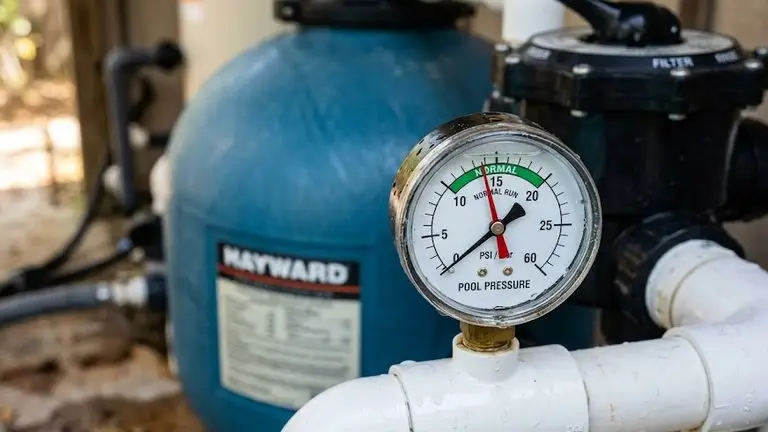
Weak flow with rising filter pressure is often not the pump at all. A loaded filter or a clogged skimmer line chokes flow and makes a healthy pump sound sick. Sometimes a filter cleaning is the whole cure.
How long do pool pumps last?
Plan on 8 to 12 years for the pump as a whole, with the motor usually giving out first, often between years 8 and 10. The wet end, meaning the housing, basket, and plumbing connections, routinely outlives the motor. That is why a mid-life motor swap used to be such a popular move, and why the post-2021 supply squeeze on replacement motors changed the calculus.
What actually determines where your pump lands in that range is how it lives. Heavy summer runtime ages a motor faster than light duty. Debris that reaches the impeller because baskets went unemptied adds wear. Water chemistry matters more than most owners realize, because unbalanced, corrosive water attacks metal components and seals from the inside. And heat is a factor too: a pump baking against a west-facing wall with no airflow runs hotter, and hot motors die young.
You can buy years with small habits. Keep the baskets empty so the pump never strains for water. Fix seal weeps and o-ring leaks the month you spot them. Keep the chemistry balanced week to week. And give the motor breathing room, since it cools itself with the air around it.
The quiet case for catching it early
Almost every pump death we see follows the same arc. A $150 symptom gets ignored for a season, becomes a $500 motor job, and ends as a full replacement. A shaft seal weeps, water reaches the bearings, the bearings sing for a few weeks, and then the motor locks on a Friday in July with the pool at 88 degrees.
This is the equipment side of the argument for weekly pool maintenance. Our technicians put hands on your equipment pad every visit, and a pump that gets heard weekly rarely gets to the locked-motor stage. It is also why our Atlanta pool maintenance cost guide budgets a $300 to $500 yearly repair reserve. Seals, o-rings, and capacitors are a matter of when, not if.
Frequently Asked Questions
How long do pool pumps last?
Most pool pumps last 8 to 12 years, and the motor usually fails first, often between years 8 and 10. Heavy summer runtime, debris reaching the impeller, unbalanced water, and poor airflow around the motor all push a pump toward the short end of that range. Atlanta’s long April-to-October season works pumps harder than the national average.
Is it cheaper to replace the motor or the whole pool pump?
A motor swap runs $200 to $800 and averages about $500, against roughly $1,300 installed for a new variable-speed pump. On a pump under 5 years old, the motor swap usually wins. On an older single-speed pump the math flips, because compliant replacement motors are getting harder to source and the new pump erases $60 to $90 a month in summer electricity.
When should I replace a pool pump instead of repairing it?
Use the 50 percent rule: when a repair quote passes half the cost of a new pump installed, replace it. Age settles the close calls. Under 5 years, repair almost anything. From 5 to 8 years, weigh the rule honestly and count the energy savings you are passing up. Past 8 years, put the repair money toward a variable-speed upgrade, since the pump is near the end of its 8-to-12-year life anyway.
How much does it cost to replace a pool pump in Atlanta?
Most homeowners pay around $1,300 all-in. The unit runs $250 to $1,000 for the few remaining small single-speed models, $300 to $1,600 for dual-speed, and $800 to $2,500 for variable-speed. Installation labor adds about $200 for a same-model swap, or $280 to $500 when switching brands, since that usually involves replumbing and rewiring.
Can you still buy a single-speed pool pump?
Mostly no. Since July 2021, a federal Department of Energy standard has required new and replacement inground filter pumps above 1.0 total horsepower to meet efficiency levels that only variable-speed pumps reach, so manufacturers stopped making full-size single-speed models. Small pumps below that threshold and certain spa and above-ground pumps are exceptions. A working single-speed pump you already own is fine to keep running.
Final thoughts
Repair the young pump, replace the old one, and let the 50 percent rule referee everything in between. And when replacement wins, do not mourn the single-speed pump. The variable-speed upgrade is quieter, mandated into the market for good reason, and pays for itself on Georgia Power’s meter in about two seasons.
Is your pump humming, screeching, or just not moving water the way it used to? BluVantage Pool Service diagnoses and repairs pumps across Buckhead, Sandy Springs, Brookhaven, Dunwoody, East Cobb, Marietta, Milton, Alpharetta, Johns Creek, and Roswell. See the neighborhoods we serve, then call 404-224-9387 or schedule a pump inspection. We will tell you honestly which side of the repair-or-replace line your pump sits on.