
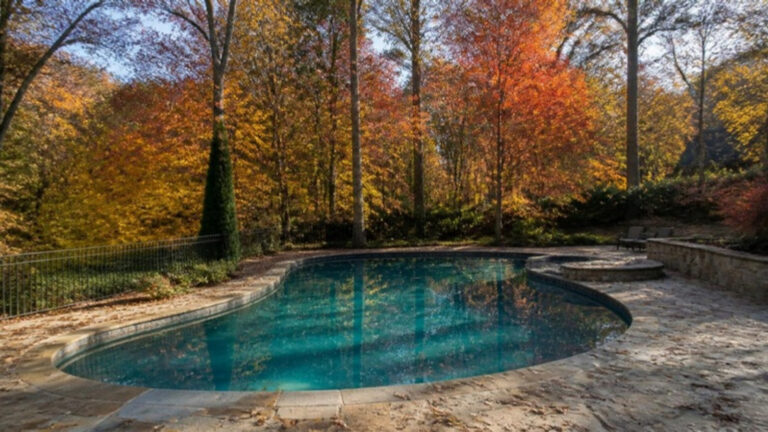
A leaf net for pool defense might be the best hundred dollars an Atlanta pool owner spends all year. Mid-October is when that becomes obvious. Our oaks, maples, and pines drop their load over about six loud weeks. An uncovered pool under canopy can collect more debris in that stretch than in the entire rest of the year. The mess on the surface is the least of it. Leaves attack a pool four different ways.
Here is what leaves actually do to water and equipment. Then the leaf net play, and the October routine that keeps the season cheap.
What leaves do to a pool, beyond looking bad
First, they eat your chlorine. Every leaf is organic material, and chlorine burns itself up oxidizing organics. That is why leaf-season pools suddenly need more sanitizer despite colder water. Second, they feed what comes next. Decomposing leaves release phosphates and nutrients, setting the table for algae the moment chlorine dips. It is the same mechanism we covered in the storm recovery guide.
Third, they stain. A leaf that sits on plaster for a few days releases tannins and leaves a brown ghost of itself on the surface. Fourth, they strangle the machinery. Leaves pack skimmer baskets, load the filter, and choke flow to the pump. A pump starved of water is a pump heading for a repair bill.
The leaf net for pool protection: how to use it
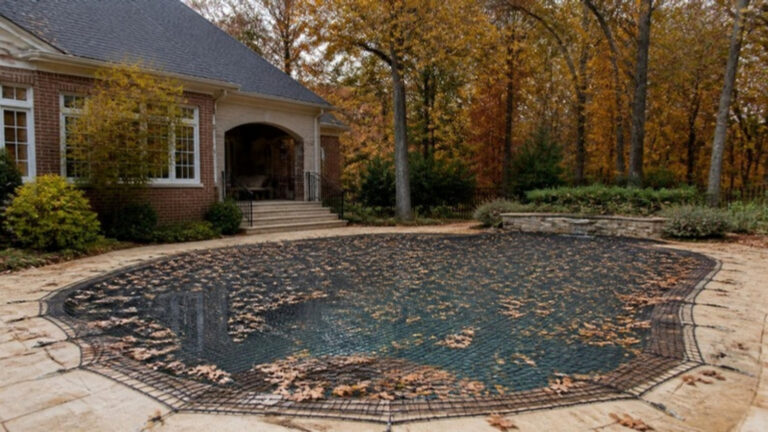
A leaf net is a lightweight mesh stretched over the water, fine enough to catch leaves and coarse enough to shed rain. It is not a safety cover and not a solar cover. This is a seasonal tool with one job: intercept the leaf drop before anything sinks. Most run $50 to $150 depending on pool size. Under heavy canopy the net pays for itself in one season of skipped vacuuming and stain treatment.
The play is simple. Stretch it over the open pool, or over the winter cover if you have already closed. Time it to your trees’ main drop, usually mid-October here per the UGA Extension’s seasonal guidance for north Georgia. Leave it up through the six heavy weeks. When the trees finish, drag the net off in one motion, leaves and all, and compost the haul. One removal replaces a season of daily skimming, and the pool underneath never met the leaves at all.
Two habits make a net work well. Pull the collected load off every week or two rather than letting a wet leaf mat sit on the mesh. A soaked mat blocks light and drips tannin tea into the water below. And size up rather than down. A net that barely reaches the edges dumps its catch into the pool on windy nights.
The October routine for open pools
Netted or not, an open pool in leaf season runs a tighter loop. Skim daily during the heavy weeks. A floating leaf costs a scoop, while a sunken leaf costs a vacuum and maybe a stain. Empty the skimmer and pump baskets every day or two. A packed basket kills circulation exactly when the pool needs it. Brush weekly, watch the corners where leaves collect, and mind the pressure gauge. Leaf season is when a filter goes from clean to overdue in ten days. Our filter cleaning crews see that pattern every October.
Test twice a week through the drop. Chlorine demand climbs with the organic load even as cool water slows algae. The owners who lose October pools are the ones who assumed cold weather meant chemistry could coast. It cannot, not with the trees feeding the water daily.
The skimmer, optimized for leaf duty
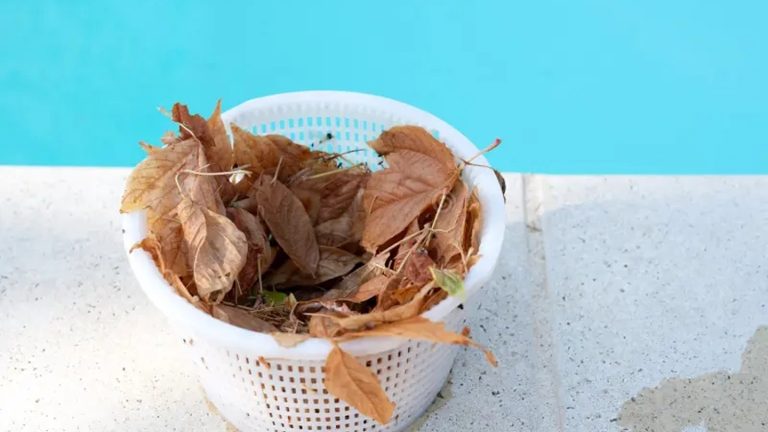
Your skimmer is the front line. Three cheap upgrades make it a better soldier. Check the weir, the little flap door at the skimmer mouth. A working weir speeds surface flow into the basket and keeps captured leaves from floating back out when the pump stops. Add a skimmer sock, a fine mesh liner inside the basket. It catches the shredded leaf bits and pine needles the basket alone passes through to the filter. And if your pool runs a suction-side cleaner, add a leaf canister in the hose line. A whole oak’s output otherwise ends up inside your cleaner’s plumbing.
When a skimmer keeps clogging faster than you can empty it, the surface load has outrun the equipment. That is the moment for the net, or for adding a mid-week service visit through the drop weeks.
Stains, and the good news about them
Brown leaf stains on plaster look alarming. They are usually the easiest stain family to fix. Tannin stains are organic, and organics yield to chlorine and patience. Brush the spot, then hold the pool at the strong end of normal chlorine or apply a small shock treatment. Most fade within days. A stubborn spot responds to a chlorine tablet held briefly over it with a tool, never a bare hand. Stains that ignore chlorine entirely are usually metal, not leaf. That is a different diagnosis, worth a water test before treatment.
Frequently Asked Questions
Is a leaf net for a pool worth it?
Under tree canopy, yes, and it is not close. A $50 to $150 net intercepts the entire six-week Atlanta leaf drop before anything sinks. It then comes off in one motion with the whole season’s load. The net replaces daily skimming, prevents tannin stains, and spares the filter. Better yet, it removes the algae fuel that decomposing leaves add to the water. Pools with no overhanging trees can skip it. Everyone else should not.
What is the difference between a leaf net and a pool cover?
The net is a light seasonal mesh with one job, catching leaves. It neither retains heat nor supports weight. A solar cover holds heat and blocks evaporation. A safety cover anchors to the deck, supports weight, and winters the pool. They stack logically. An open fall pool wears just the net. A closed pool can wear the net over the safety cover, so the leaf load never mats on the cover itself.
Do leaves make a pool green?
Indirectly, and reliably. Leaves consume chlorine as they break down and release phosphates that feed algae. A leaf-loaded pool runs low on defense and high on food at the same time. Add a warm October week and the bloom follows. The fix is prevention. Get leaves out before they sink, hold chlorine at target through the drop, and treat any green tint the day it appears rather than the weekend after.
How do I get leaf stains off the bottom of my pool?
Brush the stain, then let chlorine do the work. Hold the pool at the strong end of its normal range or apply a targeted shock. Organic tannin stains typically fade over a few days. For a stubborn spot, holding a chlorine tablet over it briefly with a pole tool speeds things up. If chlorine makes no dent at all, suspect a metal stain instead and test the water before trying stain removers.
Should I run the pump more during leaf season?
Run it smarter rather than longer. Circulation helps the skimmer capture leaves before they sink, so daytime runs during active leaf fall earn their electricity. But a clogged basket or loaded filter cancels the benefit. Pair any extra hours with daily basket checks and gauge checks. If flow looks weak at the returns, clean the path first. More hours through a choked system is just wear.
Final thoughts
Atlanta’s leaf season is six weeks of the trees testing your pool, and the winning strategy is interception. Stretch a leaf net for pool protection before the main drop. Keep the skimmer path clear daily, watch the gauge, and let chlorine handle the stragglers and their stains. Come Thanksgiving, the trees are done, the net comes off in one pull, and the pool never knew October happened.
Under heavy canopy and losing the fight? We add fall cleaning visits to any schedule. Our filter cleaning and weekly maintenance crews work all over the metro. We cover Buckhead, Sandy Springs, Brookhaven, Dunwoody, East Cobb, Marietta, Milton, Alpharetta, Johns Creek, and Roswell. See the neighborhoods we serve, then call 404-224-9387 or add a fall cleaning visit. We will take October off your plate.