
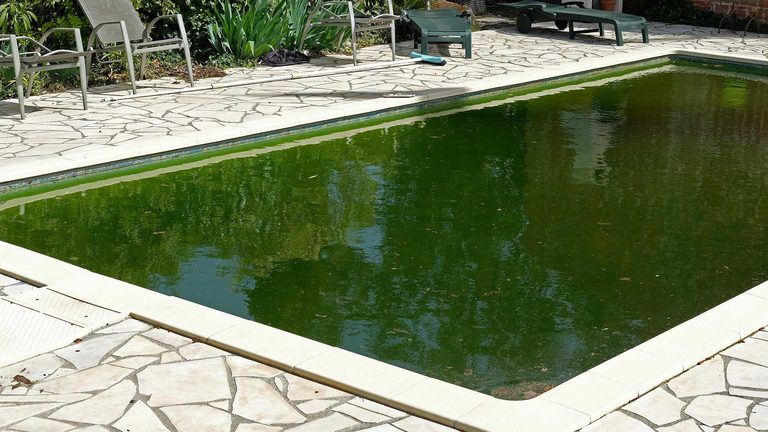
Why is my pool green? Because the algae won a race you did not know was running. Algae spores land in your water constantly, and chlorine kills them quietly all season long. The moment your chlorine falls behind demand, they multiply, and in warm water they can turn a clear pool green in less than a day. That timing explains the classic Atlanta phone call we get every July: the pool was fine Friday, and by Sunday it looks like a pond.
The good news is that most green pools are fixable in two to four days without draining a drop. This guide covers why it happened, the step-by-step recovery we use on service calls, and how to keep it from happening again in August.
Why is my pool green all of a sudden?
Green almost always means green algae, the most common of the three algae families and, fortunately, the easiest to kill. For it to bloom, something had to knock your sanitizer below the level of demand in the water. In an Atlanta summer, several things line up to do exactly that.
Water temperature is the accelerant. Once pool water pushes past the mid 80s, algae metabolism speeds up while chlorine burns off faster in the sun. A pool that coasted on 6 hours of pump time in May cannot coast in July. That is why our guide to summer pump run time recommends 8 to 12 hours in the heat.
Storms pile on. Every thunderstorm dilutes chlorine, drops pH, and washes phosphate-rich runoff into the water, and phosphates are food for the next bloom. We broke down that chain reaction in our post on what Atlanta storms do to pool water. Add a busy pool weekend, a clogged skimmer basket, or a vacation week with no testing, and the chlorine gap opens. Algae only need a day of it.
Not all green water is algae
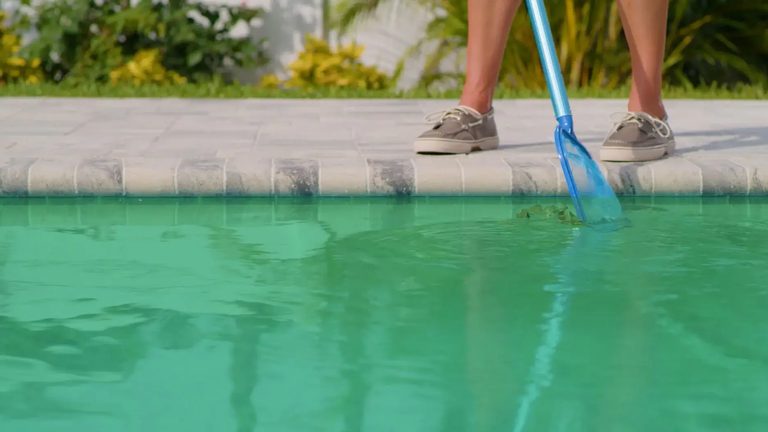
Before you buy a cart of shock, look closely at the water. Algae green is dull and murky. You cannot see the bottom, the walls feel slippery, and you may spot green patches clinging to steps and corners. That pool needs the treatment below.
Atlanta adds its own decoy in spring. During March and April, a yellow-green film across the surface is often pine pollen rather than algae, and it skims and filters out without any shock at all.
A pool that is green but clear, where you can still see the floor through tinted water, is usually a different problem: dissolved metals, most often copper. It shows up after filling with well water, or when low pH has been quietly corroding a heat exchanger. Here is the trap. Shocking a copper pool makes it worse, because high chlorine levels oxidize the metal and can stain your surfaces. Metals need a sequestering agent, not more chlorine. If you are not sure which green you have, test the water or send us a photo before you treat anything.
How to fix a green pool step by step
This is the sequence our crews run on green pool recoveries across Metro Atlanta. The order matters more than the products.
Gather the gear before you start. You want a proper test kit rather than strips, a stiff pool brush, and enough shock to dose heavy more than once. For a typical 15,000 to 20,000 gallon Atlanta pool that has gone solid green, plan on six or more pounds of cal-hypo shock. The single bag most people bring home is not enough. Running out on night one is how a two-day job becomes a five-day job.
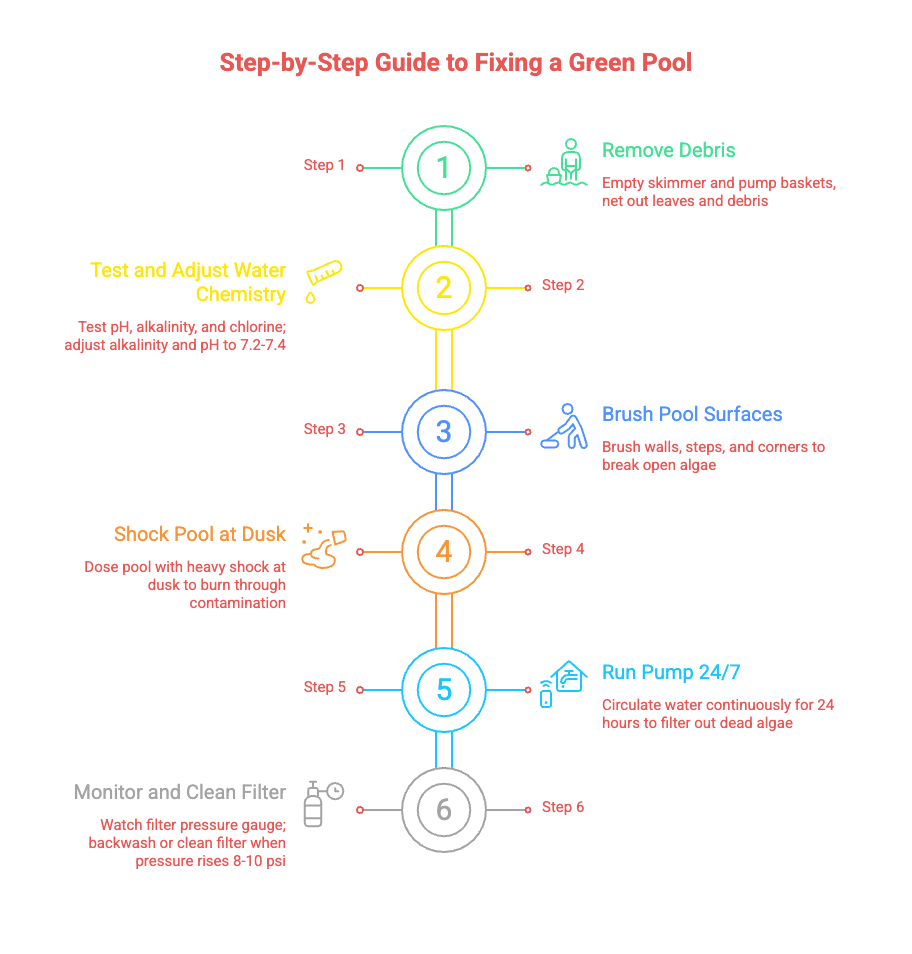
- Get the solids out first. Empty the skimmer and pump baskets, then net out leaves and debris. Every piece of organic material you remove is chlorine you will not have to spend.
- Test before you treat. You need pH, total alkalinity, free chlorine, and combined chlorine. Correct alkalinity first, then bring pH to the low end of range, around 7.2 to 7.4. Chlorine kills far more efficiently in slightly acidic water, so this step decides whether your shock works or evaporates.
- Brush everything. Walls, steps, corners, behind the ladder. Algae grow a protective outer layer, and brushing breaks it open so the chlorine can reach them. Skipping this step is the number one reason DIY shock treatments fail.
- Shock past the breakpoint. A green pool needs a heavy, deliberate dose, not a single bag of shock. The chemistry target is free chlorine at roughly ten times your combined chlorine reading, which is what it takes to burn through the contamination completely. In practice that means doubling the normal shock dose for light green water, tripling it for solid green, and quadrupling it for a dark green pool. Dose at dusk so the sun does not strip the chlorine while it works.
- Run the pump around the clock. Dead algae are fine particles, and only the filter can remove them. Give it 24 hours a day of circulation until the water clears.
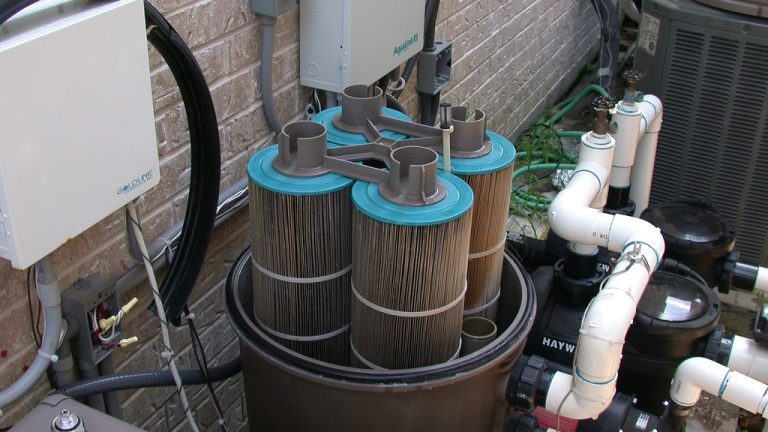
- Watch the filter pressure gauge. All that dead algae loads the filter fast. When pressure climbs 8 to 10 psi over its clean baseline, backwash or clean the cartridges and keep going. A saturated filter is the most common reason a treated pool stalls at cloudy.
Dark green pools often need a second shock on day two. Retest, confirm your pH held, and dose again. As the water turns from green to gray-blue to cloudy white, the algae are dead and the fight moves to the filter.
How long it takes, and the truth about overnight fixes
A light green pool caught early usually clears in 24 to 48 hours. A solid green pool takes two to four days of shocking, circulating, and filter cleaning. A black-green swamp that sat through a vacation can take a week or more, and at that point professional equipment moves faster than patience.
The color itself tells you whether the treatment is working. Green turning gray-blue within 12 hours of the shock means the algae are dying. Gray-blue turning cloudy white means they are dead and suspended, and the job now belongs to the filter. Cloudy white slowly turning clear is the filter winning. If the water is still the same green the morning after a full breakpoint dose, stop and retest before adding anything else. Either the pH drifted, the dose was short, or the stabilizer problem described below is blocking you.
You will see overnight-cure claims online, usually built around flocculant. Floc drops suspended particles to the pool floor, where you vacuum them to waste. In skilled hands it genuinely shortens the timeline. Done wrong, it gums up filter media and adds days. We use it selectively on recoveries, and we rarely recommend it as a first move for homeowners.
Why your pool keeps turning green
One bloom is bad luck. A pool that goes green every July is a system problem, and it is almost always one of five things.
The stabilizer has crept too high. Chlorine tablets carry cyanuric acid, a sunscreen for chlorine that accumulates with every puck. In the right amount it protects your sanitizer. Once it climbs well past the working range, roughly beyond 100 ppm, it slows chlorine’s kill speed so much that normal doses stop keeping up. Shock after shock seems to do nothing. Test for it if your pool shrugs off treatment. The only real fix is partial dilution, draining some water and refilling with fresh.
Phosphates keep arriving. Storm runoff, leaves, lawn fertilizer, and pollen all feed the water. You do not have to chase a zero reading, but a pool that drinks runoff after every storm needs its chemistry watched closely.
The filter never fully recovered. A cartridge that survived a bloom is often still packed with fine debris, so the system polishes water slower and the next bloom starts easier. A professional pool filter cleaning after any algae episode resets it.
Circulation has dead spots. Corners, steps, and areas behind ladders where water barely moves are where algae start. Weekly brushing sweeps those zones, and the operator textbooks are blunt about it: preventing algae is far easier than removing algae.
The chemistry slides between visits. Chlorine that yo-yos between fine and depleted gives algae a window every single week. This is the quiet argument for weekly pool maintenance: pools tested and balanced every seven days almost never go green, because the window never opens.
When to call in a crew, and why draining is the wrong move
Call for help when the water is so dark you cannot see the first step, or when green returns within days of a full treatment. Stubborn dark spots that brushing will not lift deserve a call too. They may be black algae, a tougher organism that needs its own playbook. Algae are more than a cosmetic issue, because a bloom can harbor bacteria. It is the reason the CDC’s healthy swimming guidance treats clear, sanitized water as a health baseline rather than a preference.
Whatever you do, resist the urge to empty the pool and start over. An in-ground shell sitting empty is vulnerable to groundwater pressure from below. In areas with a high water table, an empty pool can literally lift out of the ground. The partial drain-and-refill used to lower stabilizer is a different, safer operation. A full drain is a last resort with its own engineering precautions, and a green pool almost never requires one.
Professional green pool recovery in Atlanta runs $240 to $480 depending on how far gone the water is. We break that figure down in our Atlanta pool maintenance cost guide. Our green-to-blue treatments include the chemistry, the labor, and the filter work, with the pool typically swimmable again within days.
Frequently Asked Questions
How long does it take to clear a green pool?
A light green pool usually clears in 24 to 48 hours. A solid green pool takes two to four days of shocking, round-the-clock filtration, and filter cleaning. A dark, swampy pool can take a week or more. Watch the color: green turning gray-blue means the algae are dying, and cloudy white means the filter is finishing the job.
How much shock do I need for a green pool?
Enough to push free chlorine to roughly ten times your combined chlorine reading, the breakpoint that burns through contamination completely. In practice, double the normal dose for light green water, triple it for solid green, and quadruple it for dark green. For a solid-green 15,000 to 20,000 gallon pool, plan on six or more pounds of cal-hypo shock, dosed at dusk.
Why is my pool still green after shocking it?
Four causes explain almost every stubborn case. The pH sat above 7.6, so the chlorine worked poorly. The dose fell short of breakpoint. Cyanuric acid has climbed past roughly 100 ppm and is slowing the chlorine down, which calls for partial dilution. Or the green is dissolved copper rather than algae, and more shock makes that one worse. Retest the water before adding anything else.
Why does my pool keep turning green?
A pool that goes green repeatedly has a system problem, not bad luck. The usual suspects: phosphate-rich runoff feeding each new bloom, a filter still saturated from the last episode, dead spots that never get brushed, or chlorine that swings between fine and depleted from week to week. Pools on consistent weekly chemistry almost never go green, because the gap algae need never opens.
Can you clear a green pool overnight?
Only if it barely turned. A pool that went light green within the last day can look clear by morning after a proper shock with the pump running all night. Solid green water takes two to four days no matter what a product label promises. Flocculant can shorten the timeline in experienced hands, but used wrong it clogs filter media and adds days instead.
Final thoughts
A green pool is not a mystery and not a catastrophe. It is a chlorine deficit with a predictable fix: debris out, chemistry corrected, walls brushed, a real breakpoint shock, and relentless filtration until the water gives up. The same list, run weekly in small doses, is what keeps the bloom from ever starting.
If your pool has already gone green, BluVantage Pool Service runs green-to-blue recoveries across Buckhead, Sandy Springs, Brookhaven, Dunwoody, East Cobb, Marietta, Milton, Alpharetta, Johns Creek, and Roswell with CPO-certified technicians. See the neighborhoods we serve, then call 404-224-9387 or book an algae treatment and we will have you swimming again this week.