
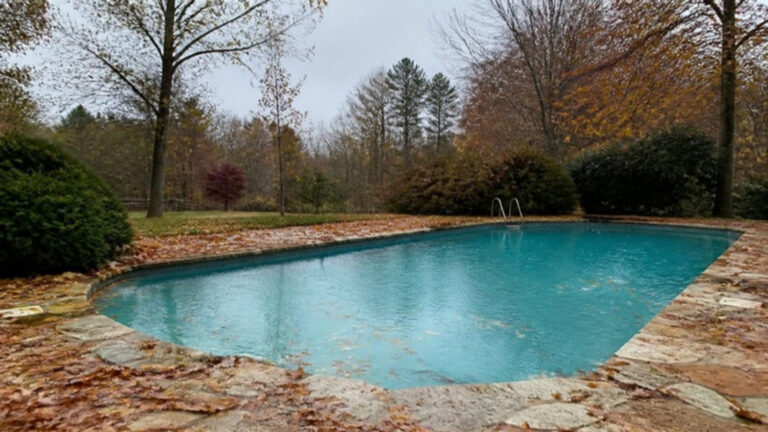
Knowing when to close pool for winter is easy in Michigan: before it freezes, no debate. Georgia hands you an actual decision. Our winters are mild enough that leaving the water open and circulating is a legitimate option. Operator guidance says exactly that for mild climates. Roughly half our clients close, half stay open, and both halves are making a defensible call.
So instead of pretending there is one right answer, here is the honest version. What closing protects, what staying open buys you, what each costs, and the framework we use when clients ask us to just decide for them.
What closing actually protects
A proper closing is armor for the months nobody swims. The cover keeps out the leaf load that would otherwise feed spring algae. Winterized plumbing, blown clear of water, cannot burst in a hard freeze. Balanced, heavily sanitized water under a cover holds well for months with no attention. And a closed pool asks nothing of you between November and March: no testing, no skimming, no pump schedule.
Closing also has one quiet structural rule attached. The water mostly stays in the pool. An empty or low shell in wet Georgia clay is a hydrostatic accident waiting to happen. A proper winterization lowers water slightly and protects the plumbing, and never drains the pool out.
What staying open buys you
An open pool in January is a better view and an intact swim option for the occasional warm snap. It also means a spring that starts with clear water instead of a cover pull and a surprise. You skip the closing and opening fees. You also never meet the swampy March pool that greets owners whose closings went wrong.
The price is continued attention. Your pump still runs, shorter but daily, and the water still gets tested weekly rather than twice weekly. Chlorine demand drops steeply in cold water, so chemical costs shrink, but they do not vanish. And you own one new responsibility that matters more than all the rest: freeze protection.
The freeze-night rule for open pools
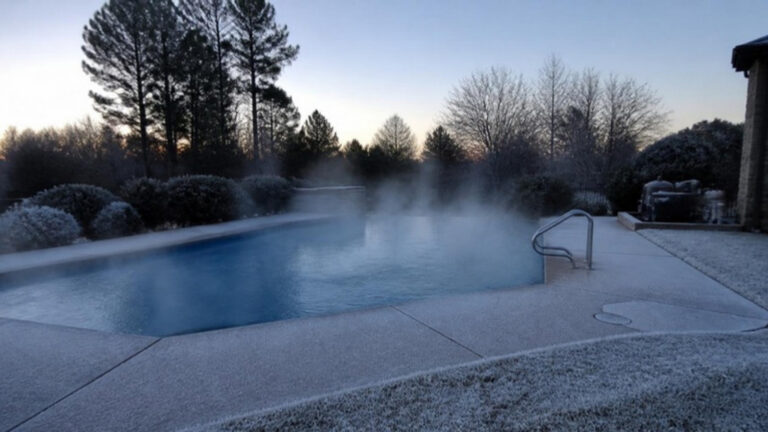
Moving water does not freeze in Atlanta’s kind of cold. When a night dips below about 35 degrees, the answer is simple. Run the pump, all night, water moving through every line. Modern automation does this automatically with a freeze-protect setting that watches air temperature for you. If your equipment has it, staying open carries little risk here. But say your pool runs on a basic timer and you travel in winter. One forgotten 25-degree night can cost you a cracked pipe or a pump repair.
That single fact does most of the deciding. Automation with freeze protection makes open-all-year easy. No automation makes closing the safer default for anyone who cannot personally babysit cold nights.
The honest cost comparison
- Closing route: a professional close runs a few hundred dollars, the spring opening similar, plus a cover if you need one. In exchange you get four months of near-zero running costs and zero labor.
- Open route: winter electricity for reduced pump hours, a light chemical budget, and weekly attention from you or a service. No open/close fees, no cover, no spring surprises.
- The math lands close to even for most Atlanta pools. Ten-year totals differ less than people expect, which is why lifestyle, not money, should make this call.
The decision framework we use
Close if most of these sound like you. The pool sits under heavy tree canopy that will fill it all winter. You travel during the cold months. The equipment lacks freeze protection. Nobody looks at the pool from the house anyway. A closed pool under a good cover is the low-stress winter for that household.
Stay open if these fit better. The equipment pad has automation with freeze protect. The pool is part of the view you live with daily. You kept up with the weekly maintenance plan and the pool is in good shape. Or a spa shares the system and you want it hot in January. Salt pool owners should note one wrinkle. Cells stop producing in cold water, so an open salt pool supplements with liquid chlorine through winter, as covered in our salt water pool guide.
When to close pool for winter: the 60-degree rule
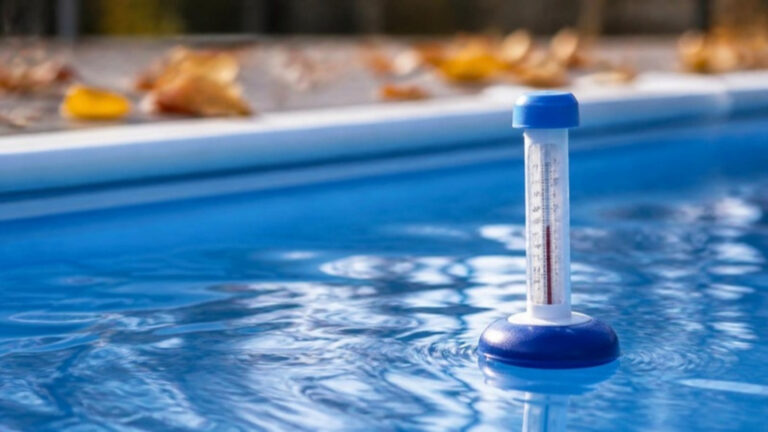
The trigger is water temperature, not the calendar. Close when the water sits consistently below 60 degrees. In metro Atlanta that usually means late October into November, right around the metro’s average first freeze in the National Weather Service’s local climate records. Close earlier, while the water is warm, and you seal a cozy incubator. Algae grows happily under a cover in 70-degree water with no circulation and fading chlorine. That pool opens green in March.
Waiting for cold water flips the odds. Below 60 degrees, algae metabolism crawls and chlorine holds. What you seal in October stays very close to what you will meet in April. The two weeks of patience in late October are the highest-return waiting a Georgia pool owner does all year. The full step-by-step lives in our closing guide, coming soon on the blog. And if you want the work handled, our closing slots book out fast once the first cold front hits.
Frequently Asked Questions
When should you close a pool for winter in Georgia?
When the water temperature holds consistently below 60 degrees, which in metro Atlanta typically means late October into November. The calendar date matters less than the water number. Closing while the water is still warm seals in conditions where algae keeps growing under the cover. That mistake is the number one cause of the green March opening.
Can you leave a pool open all winter in Georgia?
Yes, and many metro Atlanta pools do. Operator guidance recognizes that mild climates can leave water in the pool and circulating through winter. The requirements are modest. Keep the pump on a reduced daily schedule, hold light chlorination, test weekly, and run water through all lines on freeze nights. Equipment with automatic freeze protection makes it nearly hands-off.
Do pools freeze in Atlanta?
The pool itself, no. Metro Atlanta cold snaps are too short to freeze a pool solid. A sheet of surface ice on a still pool is rare and mostly harmless. The real risk is the plumbing and equipment. Pipes, pumps, filters, and heaters hold small volumes of water that can freeze and crack in a single hard night. That is why open pools run the pump on freeze nights and closed pools get their lines blown clear.
Is it cheaper to close the pool or keep it open?
Closer than you would guess. Closing costs show up as the close and open service fees plus a cover. Staying open costs show up as winter electricity, light chemicals, and attention. For a typical Atlanta pool the ten-year totals land in the same neighborhood. Make the call on lifestyle: whether you want the view and the readiness, or the zero-effort winter.
What happens if you never close a pool and skip winter care?
The middle path, open but ignored, is the one truly bad option. An open pool with no circulation, no chlorine, and no freeze plan collects leaves and grows algae in every warm stretch. It also exposes plumbing on cold nights. By spring it costs more to recover than a full year of either proper choice. Pick a lane: close it properly, or keep it open with the reduced winter routine.
Final thoughts
In Georgia, when to close pool for winter has a two-part answer. If you close, do it when the water holds below 60 degrees, done properly, plumbing protected. If you stay open, keep the reduced routine and respect freeze nights. Both paths open beautifully in April. The only losing move is the ignored middle.
Deciding is free: tell us about your pool and we will give you a straight recommendation. Then either reserve a pool closing slot before the calendar fills, or ask about winter-schedule maintenance plans. We serve Buckhead, Sandy Springs, Brookhaven, Dunwoody, East Cobb, Marietta, Milton, Alpharetta, Johns Creek, and Roswell. See the neighborhoods we serve or call 404-224-9387. Either way, your pool winters well.