
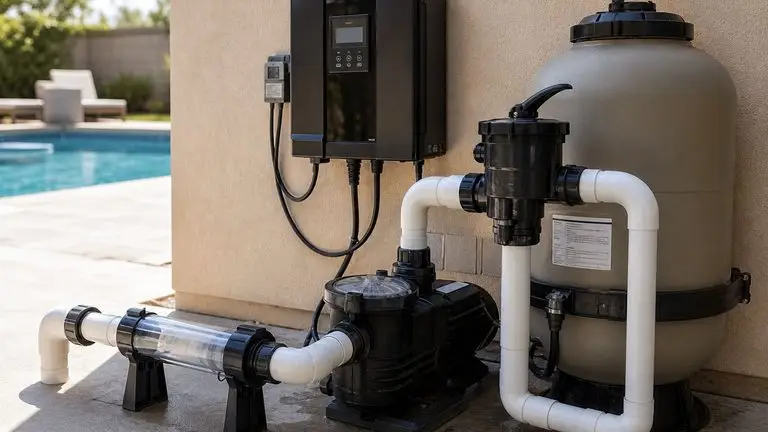
Salt water pool maintenance has a reputation problem, and the problem is the sales pitch. Somewhere between the showroom and the backyard, “easier to maintain” became “maintains itself,” and that gap produces a steady stream of August service calls. The truth sits comfortably in the middle. A salt pool really does need less day-to-day fussing than a traditional chlorine pool. It still needs a weekly routine, a set of target numbers, and care for the one expensive part doing all the work.
Here is the complete picture for Atlanta owners. It covers how the system works and the schedule that keeps it happy. It also covers the salt cell habits that decide whether you replace a $400 part in year three or year seven.
How a salt water pool actually works
Start with the fact that surprises most new owners: you own a chlorine pool. The salt is not the sanitizer. Your generator’s cell contains layers of electrically charged plates. As water flows past them, electrolysis converts dissolved salt into free chlorine, the same sanitizer every pool uses. The operator references put the working salt level at 3,000 to 3,500 ppm for most systems. Establishing that takes roughly 250 pounds of salt per 10,000 gallons. That is about a tenth as salty as the ocean, right around the saltiness of a teardrop.
So a salt system is not a chlorine-free pool. It is a chlorine factory that manufactures sanitizer on site, steadily, every hour the pump runs, instead of you pouring it in from a bucket. That steadiness is the real luxury. It is also why the system only works while water is moving. The generator interlocks with the pump and shuts down when flow stops, partly to vent the trace hydrogen gas the process produces. Our guide to summer pump run time matters double for salt pools, since pump hours are chlorine-making hours.
The salt water pool maintenance schedule
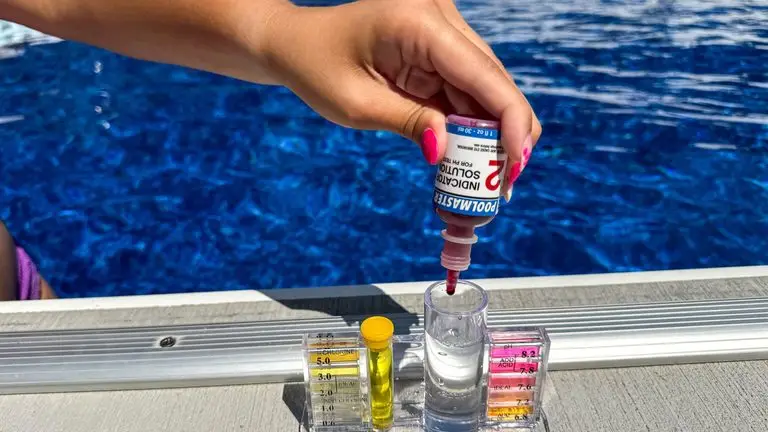
Weekly, test free chlorine and pH, then skim, brush, and empty the baskets like any pool. That testing matters even though the system automates dosing. The generator makes chlorine at whatever rate you set, not at whatever rate the pool needs. A heat wave, a storm, or a pool party changes the demand, and only a test tells you the output setting has fallen behind.
The pH deserves special attention in a salt pool. These systems push pH upward slightly but constantly, a known trait of the chemistry. Expect to add small doses of acid on a rhythm that a traditional pool never needed. Owners who skip this step get more than eye-stinging water. They get scale, and scale lands first on the expensive part.
Monthly, test what changes slowly: salinity, total alkalinity, cyanuric acid, and calcium hardness. Trust a test kit over the generator’s salt display, since readouts drift as cells age. Quarterly, inspect the salt cell itself. And once or twice a season, top up the salt, almost always after heavy dilution rather than on a calendar.
The numbers that keep a salt pool happy
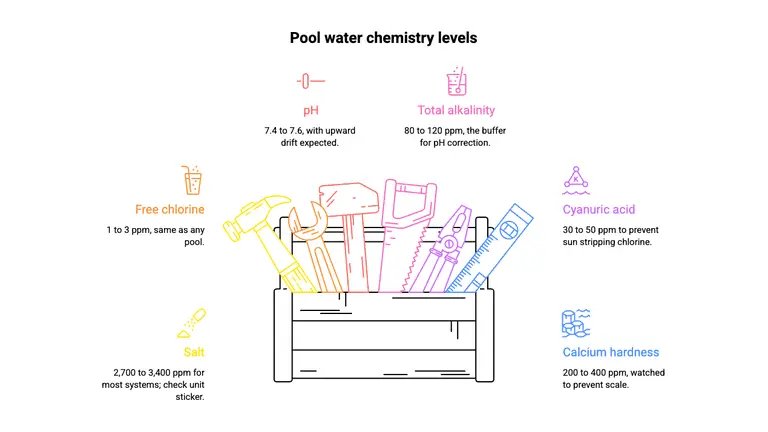
- Salt: 2,700 to 3,400 ppm for most systems, and your unit’s sticker wins any argument. Below range, the cell strains and shuts down. Far above range, you are inviting corrosion.
- Free chlorine: 1 to 3 ppm, same as any pool.
- pH: 7.4 to 7.6, with upward drift expected and small acid doses as the standing correction.
- Total alkalinity: 80 to 120 ppm, the buffer that keeps the pH correction from bouncing.
- Cyanuric acid: 30 to 50 ppm so the sun does not strip your chlorine. Never let it climb far past that, since high stabilizer slows chlorine in any pool, a trap we covered in the green pool guide.
- Calcium hardness: 200 to 400 ppm, watched closely because high calcium plus a salt cell equals scale.
Salt cell care: protecting the $700 part
The cell is the heart of the system and the part that fails first. Replacement runs $190 to $670 depending on the model, a line item we budget for in our Atlanta pool maintenance cost guide. Everything in this section exists to postpone that bill.
Inspect it every three months. Shut the system off, pull the cell, and look through it at the plates. White, crusty deposits are calcium scale, the same mineral that clogs heaters. Scale on the plates chokes chlorine production while forcing the unit to work harder. Many newer cells fight scale automatically by reversing polarity on a cycle, which helps and does not exempt you from looking.
Clean gently and only when needed. Start with a garden hose, which removes loose buildup without touching the plate coatings. For stubborn scale, a dilute muriatic acid soak, around five parts water to one part acid, dissolves the deposits in minutes of foaming. The habit to avoid is casual acid washing. Every soak shaves a little life off the plates’ coating, so acid is the response to visible scale, never a routine.
Cheapest of all is prevention. Scale forms fast in high-pH, high-calcium water. Owners who stay on top of the acid doses and keep calcium in range often go years without needing to acid-wash at all. It is the quiet reason well-kept cells reach year seven while neglected ones die at year three.
Why Atlanta salt pools drift out of tune
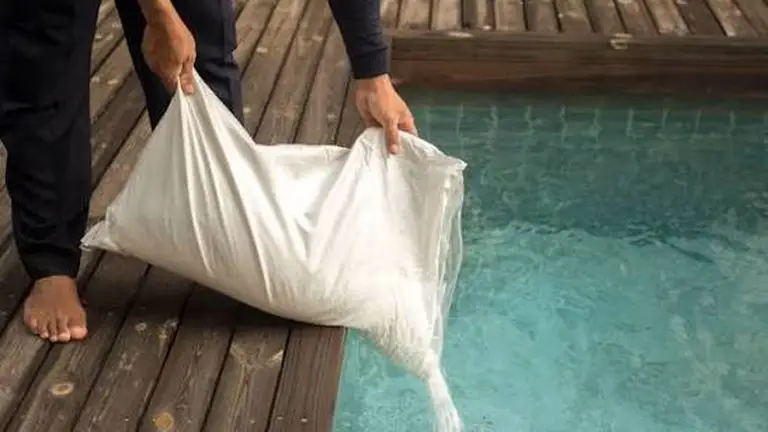
Our summer storms are dilution events. Every big rain lowers the salt concentration along with the chlorine, the same chain reaction behind post-storm cloudy water. After a week like our typical July, a salt reading that started at 3,200 ppm can slide below the generator’s cutoff. If your system throws a low-salt alarm in the rainy stretch, test before you pour. The fix is usually a bag or two, not a crisis.
The other Georgia quirk arrives in the shoulder seasons. Salt cells stop producing chlorine in cold water, with most units cutting off somewhere near 60 degrees. Atlanta pools that run year-round hit that window in late fall and early spring, and the pool still needs sanitizer when the generator naps. The answer is supplementing with liquid chlorine through the cold months, a detail that surprises owners in their first November.
One more local note for pools with stone or travertine coping. Salt splash-out is mildly corrosive to the surroundings, so rinsing the deck edge during your weekly routine spares the masonry. It is a two-minute habit that older salt pools visibly reward.
What a salt system does not change
The generator replaces the chlorine bucket and nothing else. The filter still loads up and needs its cleanings. The walls still need brushing, the baskets still need emptying, and algae still takes any opening you give it, salt or no salt. A salt pool that skips its routine goes green exactly as fast as any other pool. Water only stays sanitary when chlorine production keeps pace with demand. The CDC’s healthy swimming guidance draws no distinction between salt and traditional pools for a reason: by the time the water touches a swimmer, both are chlorine pools.
What does change is the feel and the rhythm. The water is softer on skin and eyes, and the chlorine level stops yo-yoing between service visits. Your daily question shifts from “did I add enough?” to “is the machine keeping up?” Most owners find that a fair trade. Regret only shows up in the ones who were promised there was no machine to check.
The mistakes we fix most often
Trusting the display instead of the water. Salt and output readings on the control panel drift as the cell ages. We regularly meet pools running blind on a readout that is 400 ppm off. Test monthly with a kit or strips and calibrate your trust accordingly.
Shocking with cal-hypo. Granular calcium hypochlorite works, but every dose adds calcium to water that a salt cell already wants to turn into scale. Use the generator’s boost mode for routine shocking, or liquid chlorine when the pool needs a real dose.
Cranking output instead of fixing chemistry. When chlorine keeps testing low, the tempting move is setting the generator to 100 percent. If stabilizer is low, the sun is eating the chlorine as fast as the cell makes it. If stabilizer is far too high, the chlorine is there and working slowly. Either way the cell burns its remaining life compensating for a $15 chemistry fix.
Letting pH run high for months. This is the scale story again, and it is the most expensive habit on the list. The bill arrives as a dead cell and a clogged heater instead of as a line item you can see.
Frequently Asked Questions
How often do you add salt to a salt water pool?
Once or twice a year for most Atlanta pools. Salt does not evaporate or get used up, so it only leaves the pool through splash-out, backwashing, draining, or heavy rain overflow. A new pool takes roughly 250 pounds of pool salt per 10,000 gallons to reach the operating range. After that, test monthly and add small amounts when a storm or a big top-off dilutes the level below your system’s target, usually 2,700 to 3,400 ppm.
How long does a salt cell last, and what wears it out early?
A salt cell lasts 3 to 7 years, and replacement runs $190 to $670 depending on the model. Four habits decide which end of that range you get. Letting pH run high coats the plates in scale. Acid-washing the cell on a routine schedule strips the coating that makes it work. Running the cell in cold water strains it for little output. An undersized cell that runs at 100 percent all season wears out years ahead of one with capacity to spare.
Can you shock a salt water pool?
Yes, and sometimes you should. The generator’s boost or super-chlorinate mode covers small demand spikes, like a pool party or a hot weekend. For a real problem such as algae, boost mode is too slow, so use liquid chlorine instead. Avoid granular calcium hypochlorite in a salt pool. It sanitizes fine, but every dose adds calcium to water that the cell is already trying to turn into scale on its own plates.
Do salt water pools keep working through Atlanta winters?
Not on their own. Most salt cells cut chlorine production when water temperature drops to around 60 degrees, and many shut off completely to protect themselves. Atlanta pools that run year-round sit in that window from late fall through early spring. The water still needs sanitizer during those months, just less of it, so plan on supplementing with liquid chlorine until the water warms back up and the cell resumes production.
Is a salt water pool cheaper to maintain than a chlorine pool?
Close to break-even once you count everything. Skipping weekly chlorine purchases saves a few hundred dollars a year, and salt itself is cheap. But a $190 to $670 cell replacement every 3 to 7 years claws most of that back, and the electricity to run the generator adds a little more. The honest reason to choose salt is not savings. It is softer-feeling water and a chlorine level that holds steady between service visits instead of spiking and crashing.
Final thoughts
A salt pool keeps its promise when you keep your half of the bargain. That means a short weekly routine, honest monthly testing, quarterly minutes with the cell, and respect for the pH drift that never stops. Do that and the system hands you years of steady, soft-feeling, self-made chlorine. Skip it and you meet the $700 part sooner than the brochure implied.
Would you rather hand the whole checklist to someone who does it every week? Our weekly pool maintenance plans cover salt water pools across Buckhead, Sandy Springs, Brookhaven, Dunwoody, East Cobb, Marietta, Milton, Alpharetta, Johns Creek, and Roswell, cell inspections included. See the neighborhoods we serve, then call 404-224-9387 or request a salt-system service plan and we will keep the factory running.